The Twenty-Quid Question: Telling a Car-Boot Bargain From a Money Pit
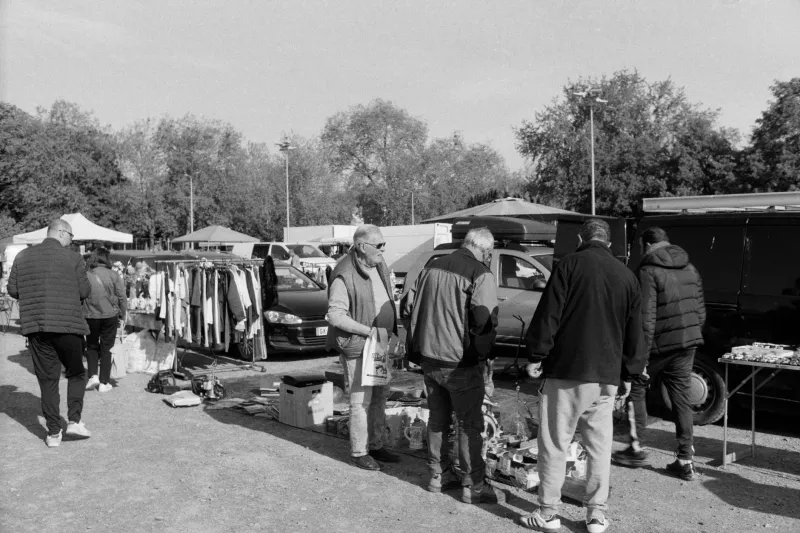
There's a particular kind of Sunday morning that gets under your skin. Six-forty, a rugby club field somewhere off the A-road, everything beaded with condensation, and a bike propped against a pasting table with a hand-written card that says £20 ONO. It's got a Reynolds sticker, mudguard eyes and a saddle that's clearly been rained on since the mid-nineties. You are, quite suddenly, in love.
That's the moment to slow down. Not because cheap bikes are a scam — some of the best bikes I've ever ridden cost less than a round of drinks — but because a £20 bike is never really a £20 bike. The question isn't whether it's cheap. It's whether it's cheap enough.
The five-minute kerbside audit
You don't need a workshop stand to make a decent judgement. You need a torch, a multitool, and the discipline not to hand over cash before you've done the rounds. Do it in the same order every time and it becomes second nature.
Frame first. Sight down the tubes like you're checking a pool cue. Look for dents on the top tube, ripples or wrinkled paint near the head tube and bottom bracket junctions, and anything that looks like a hairline crack under the lacquer. Flip it over and inspect the underside of the chainstays — that's where a dropped chain has been quietly chewing metal for twenty years.
Wheels second. Spin each one. A wobbly rim is a truing job, not necessarily a disaster. A rim whose braking surface has gone concave, or where you can see daylight through a crack at a spoke hole, is a wheel that needs replacing — and that changes the maths considerably.
Then the moving bits. Grab the cranks and rock them side to side: play in the bottom bracket is normal for an old bike and easy to fix. Grab the forks and rock the front end with the brake on — a loose headset is fine, a creaking, indexed one less so. Check the seatpost actually moves. This is the single most important two seconds of the entire inspection, and I'll explain why in a moment.
Finally, the chain. If you've got a chain checker in your pocket (and at a car boot, you should), use it. If not, lift the chain off the front chainring at the three o'clock position. If you can see daylight under more than a couple of teeth, the chain, cassette and probably the chainrings have all gone. That's a drivetrain, not a quick fettle.
And while you're down there: read the frame number and photograph it. A quick check against the BikeRegister and Stolen Bikes UK listings takes thirty seconds and occasionally saves you from buying someone else's loss.
The faults that quietly write off a frame
Here's the honest list. Any of these and you should smile, say thanks, and keep walking — no matter how lovely the lugwork.
- A seized seatpost. Alloy post in a steel frame, left outside for a decade, is a genuine nightmare. Sometimes it comes out after a week of penetrating oil and patience. Sometimes it never comes out, and you're stuck riding a bike that fits whoever owned it in 1994. Treat it as a walk-away unless the frame is something special.
- Cracks or ovalisation at the head tube. That's a frame builder's job, and frame builders charge frame-builder money.
- A bent fork or a misaligned rear triangle. Easy to miss, horrible to live with, and a sign the bike has had a proper argument with a car.
- Rust perforation. Bubbling paint is one thing. A screwdriver going through a chainstay is another.
- Wrecked bottom bracket threads. Cross-threaded or stripped threads in the shell can sometimes be chased or sleeved, but it's a machinist's job and often costs more than the frame is worth.
Beyond the frame itself, watch for parts you simply can't get. Twenty-six-inch wheels are still well served, but some older French and Italian threading, obscure hub gears and one-off brake standards will have you trawling eBay for months. Check before you commit, not after.
So what does the rescue actually cost?
The £20 is the entry fee, not the price. A realistic DIY refresh on a bike that's been sitting in a shed looks roughly like this: cables and outers, £15–25. Chain, £12–20. Cassette or freewheel, £20–35. A pair of decent tyres and tubes, £45–70. Brake pads, £10–20. Bar tape or grips, £10–15. Bearings and grease, a tenner. That's somewhere between £110 and £175 in parts alone, before you've touched a wheel that needs truing or a hub that wants servicing.
If you're paying a shop to do the work, add £100–150 of labour and you're looking at a £250 bike. Which is fine — genuinely fine — as long as you knew that going in. A well-chosen £20 frame with £150 of new consumables is a far better bike than a £200 new one from a supermarket, and it'll last longer. But you have to want the project, not just the bargain.
Where the good ones hide
Quality tends to survive. A 1990s rigid mountain bike with a decent cro-moly frame, rack and guard mounts and cantilever bosses is one of the most useful objects ever made. A Dawes Galaxy-shaped tourer with a rusty chain is a touring bike waiting to happen. A hub-geared commuter with a dead tyre is often a brilliant winter hack. Look for mudguard clearance, braze-ons, a decent set of wheels and a frame that fits you — because no amount of fettling fixes the wrong size.
And look for the bike whose owner clearly loved it once. Original paint, tools in the saddlebag, a pump still clipped to the frame. Neglect is cheap to fix. Contempt is not.
The bit that makes it worth it
There's a real satisfaction in a rescue build that has nothing to do with saving money. It's the same feeling as the workshop nights and the shared stands and the loaner bikes that come back cleaner than they left — a sense that good things shouldn't be thrown away just because they need a bit of attention. If you get the bike home and discover it's not for you, a car-boot rescue makes an excellent donation to a local co-op or a friend who's been thinking about commuting.
So take the torch. Take the chain checker. Take twenty quid in cash and a firm intention to walk away twice before you buy once. And when you find the right one — the right frame, the honest wear, the price that leaves room for a proper refresh — hand over the money and enjoy the walk back to the car. That's the whole point of a Sunday morning.