The Stand Next Door: How UK Bike Co-ops Turn Spare Parts into Shared Knowledge

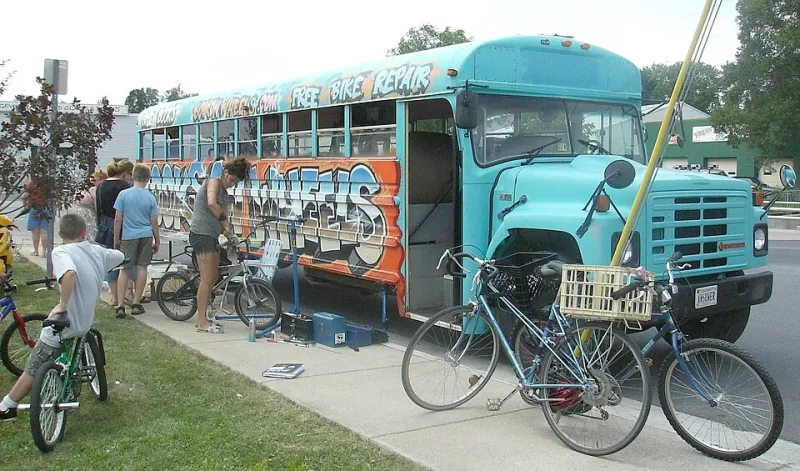
Photo: Sludge G, CC BY-SA 2.0, via Wikimedia Commons
There is a particular sound to a healthy bike co-op. A freewheel ticking while someone behind you asks whether anyone has seen the 24mm socket. A kettle clicking off. Two riders arguing gently about whether that chain is worn or just thirsty. It is not a bike shop, and it is not quite a shed, either. It is the stand next door — and in 2026, with new bike prices still making eyes water, it is one of the most useful spaces a UK rider can have on their doorstep.
First, What Counts as a Co-op?
Not every shared workshop is a workers’ co-operative, and that is fine. The UK has a healthy mix of bike kitchens, community workshops, repair cafés, library-of-things projects and tool libraries. Some are member-owned. Some are charities. Some are a couple of volunteers in a church hall with a stand, a crate of spanners and a very good biscuit rota.
A tool library is the simplest version: you borrow the cassette tool, the torque wrench or the headset press, then bring it back before someone else needs it. A bike co-op usually adds stands, workshop space, volunteer know-how and often a stash of used parts. The best ones blur the lines. You arrive to borrow a tool and leave having learned why your bottom bracket was creaking.
Finding Your Nearest Hive
Start with the obvious local networks. Ask at an independent bike shop — the good ones know who is doing community work nearby. Check with your cycling club, the council’s active travel team, a local Repair Café, or a Library of Things. Search for bike kitchen, bike co-op, community bike workshop and tool library alongside your town or city. Bristol, Leeds, Manchester, Sheffield, Edinburgh, Glasgow, Cardiff and London all have long-running projects, but smaller towns often have pop-ups and monthly sessions that do not show up on the first page of a search.
Call or message before you turn up. Opening hours can be volunteer-shaped, and many places run inductions or booked sessions rather than a permanent drop-in. Ask what the score is: membership fee, stand hire, tool loan, parts availability, whether you need to bring your own consumables. A quick question saves a wasted Saturday.
What to Bring — and What Not To
Bring your bike, obviously. But also bring the bits you actually intend to fit, a note of any torque figures or manual pages you need, and a way to pay for consumables. Co-ops are not free bike shops. They often charge a small amount for stand time, brake cables, inner tubes or workshop supplies, and that money keeps the lights on.
Bring patience, too. A co-op is not a pit stop. If you are attempting a full strip-down and rebuild, book the time or ask whether it is a quiet session. Do not roll in at ten minutes to closing with a seized seatpost and a hopeful expression. And please do not dump a filthy bike on the stand and vanish — a quick wipe-down is basic courtesy, especially when the next person is waiting.
Workshop Etiquette That Keeps the Peace
Every co-op has its own rhythm, but the same rules travel well. Do the induction. Book the stand. Ask before you rummage through the parts bins. Return tools to the wall, not to the bench. Clean up your oil, swarf and cable offcuts. Do not adjust someone else’s bike without being asked. And if a volunteer is helping you, listen — they are not there to do the job for you, they are there to show you how.
There is also the matter of noise and space. Do not hog the only stand for three hours if there is a queue. Do not fire up the compressor without checking. Do not treat the workshop as a place to leave your half-finished project for a fortnight unless that is explicitly allowed. The hive works because everyone leaves it ready for the next rider.
The Hive Mind Bit
The real value of a co-op is not the tools. It is the person who says, try the other end of that cable, or, that noise is your jockey wheel, not your hub. It is the rider who has already made your mistake and can save you an hour. It is the shared knowledge that gets passed around with the tea.
That is why the best co-ops feel like a conversation rather than a service counter. You are not paying for a repair. You are paying for access: to a stand, to a torque wrench, to a brain that has seen a hundred bottom brackets. Use that access properly and you will leave with more than a fixed bike. You will leave knowing how to fix the next thing.
Giving Back Without Burning Out
Co-ops run on favours, and favours run out if nobody reciprocates. The simplest way to give back is to become a reliable volunteer, even if it is one session a month. Turn up when you say you will. Learn the induction. Help with the boring jobs — sorting bolts, cleaning benches, checking the loan logs. Donate serviceable parts rather than broken ones. Bring biscuits. Pay your membership without being chased.
If you have a skill, share it. A wheel-truing demo, a brake-bleed session, a basic maintenance night for newcomers — these are the things that keep a workshop buzzing. And if you are the experienced one, remember that the point is to make yourself less necessary, not more. Teach the next rider to do it themselves.
Make It a Habit
A bike co-op or tool library is not a charity shop for bikes. It is infrastructure. It keeps older bikes on the road, keeps useful parts out of skips and keeps riders from buying a one-use tool they will need exactly twice. In a country where the weather, the roads and the price of a decent groupset all conspire against us, that matters.
So find your nearest hive. Book the induction. Bring your bike and your patience. Ask the daft question. Then, when you know the answer, stick around long enough to pass it on. The stand next door only stays open because riders keep using it — and keep giving back.